
As an artist, Ismail Gulgee worked in various media, including painting, calligraphy and, unusually, inlaid hardstone, a technique often referred to as pietre dure (hard stone) in the European context and parchīnkārī (literally in Persian, the ‘craft of making hedgerows’) in India and Pakistan. In India, it was applied as a decorative technique to architecture and stone objects, while in Europe, it was often applied as decorative panels to furniture. From about the seventeenth century, it was also used to make larger-scale figurative compositions. Most of the workshops that developed this technique were located in Florence, Italy, though a well-known Florentine group, the Castrucci family, flourished in Prague under Emperor Rudolph II. Gulgee appears to have been inspired in part by the pictorial potential of the Castrucci compositions in stone, while adopting an entirely original style and subject matter. The dynamism of the posture of the Indian classical dancer in jade mosaic recalls Gulgee’s paintings, which are however, mainly abstract or related to calligraphic shapes. This work has a companion piece in blue lapis lazuli, now part of the collections of the Aga Khan Museum, Toronto.

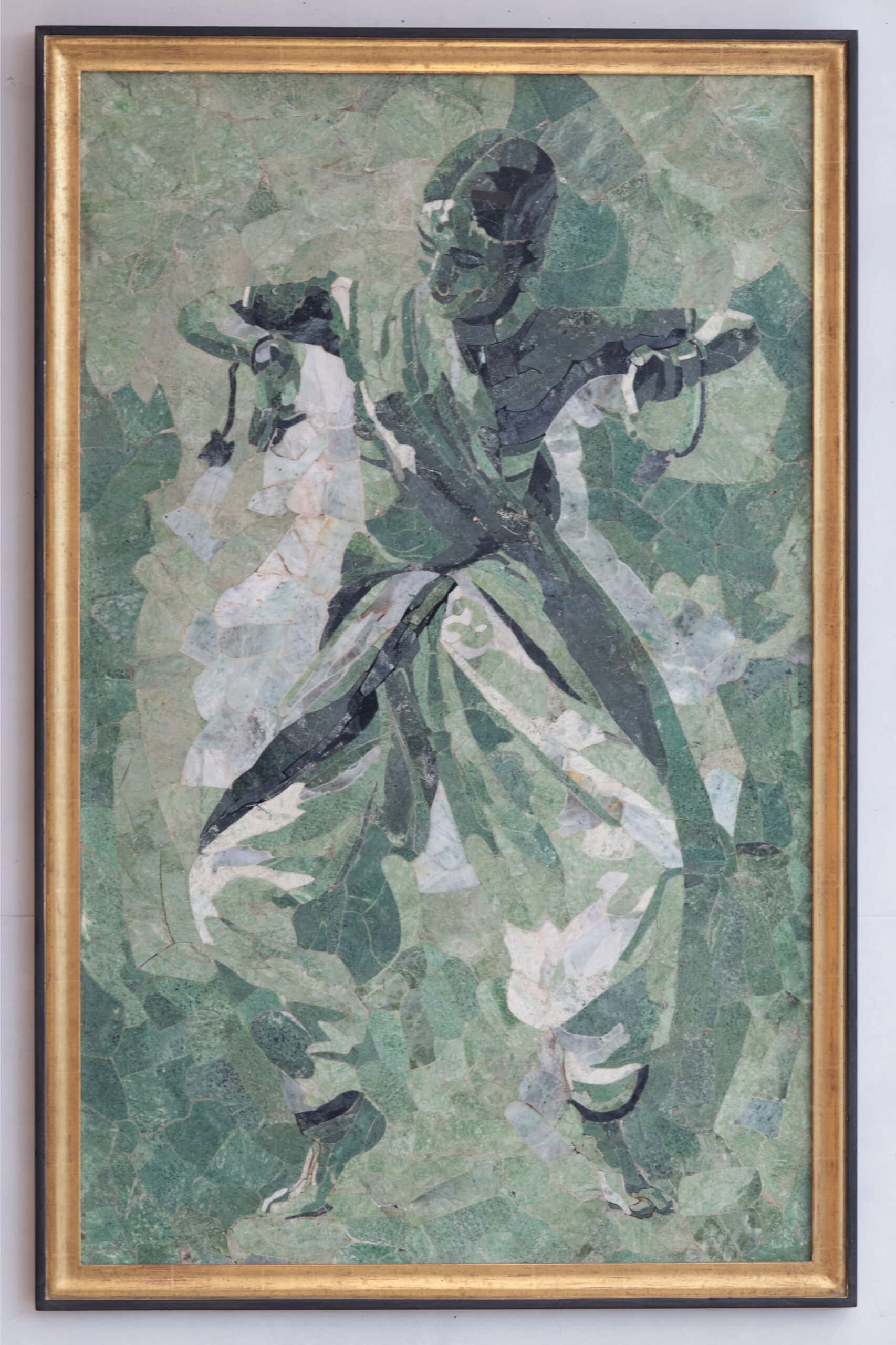
Kathak Dancer