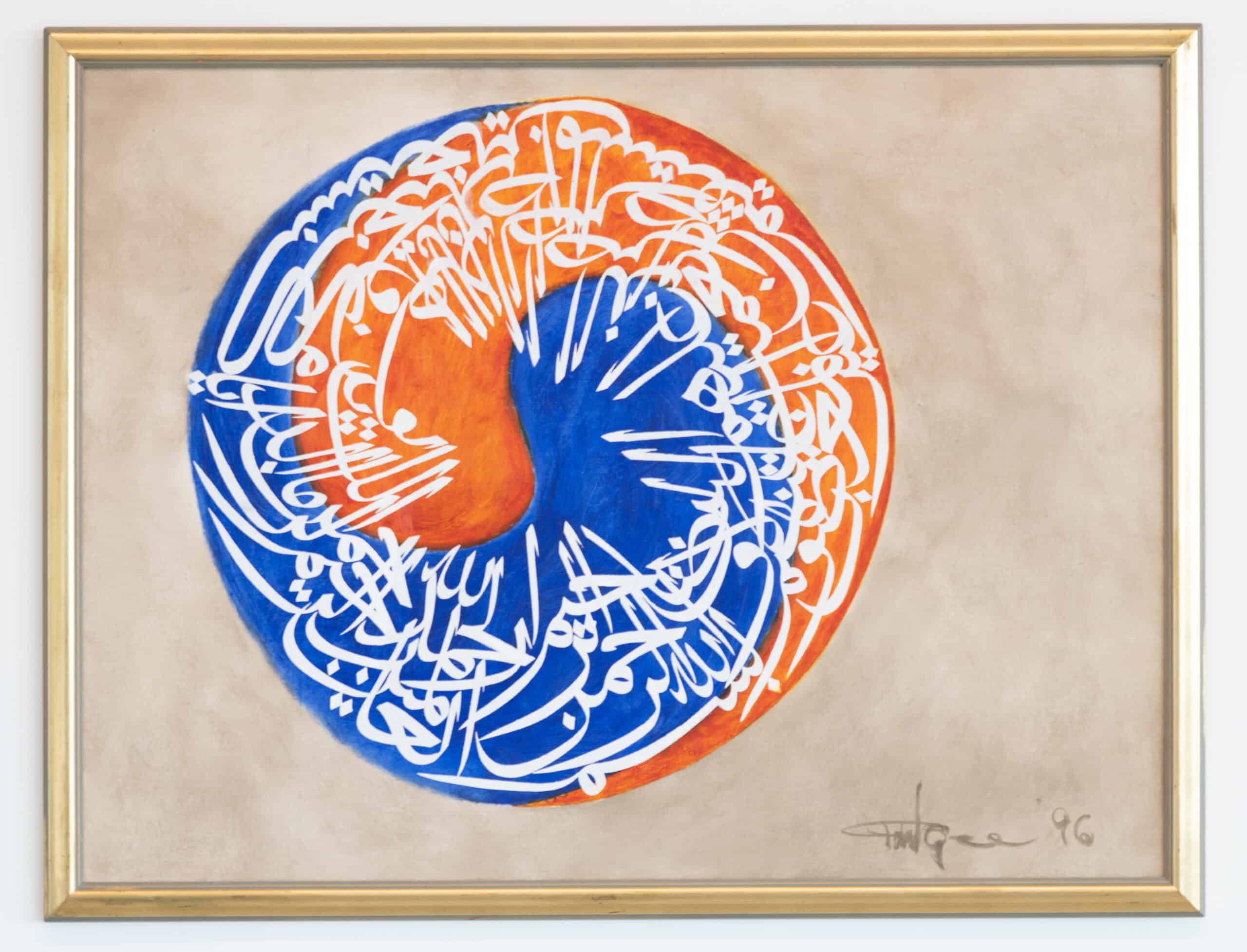
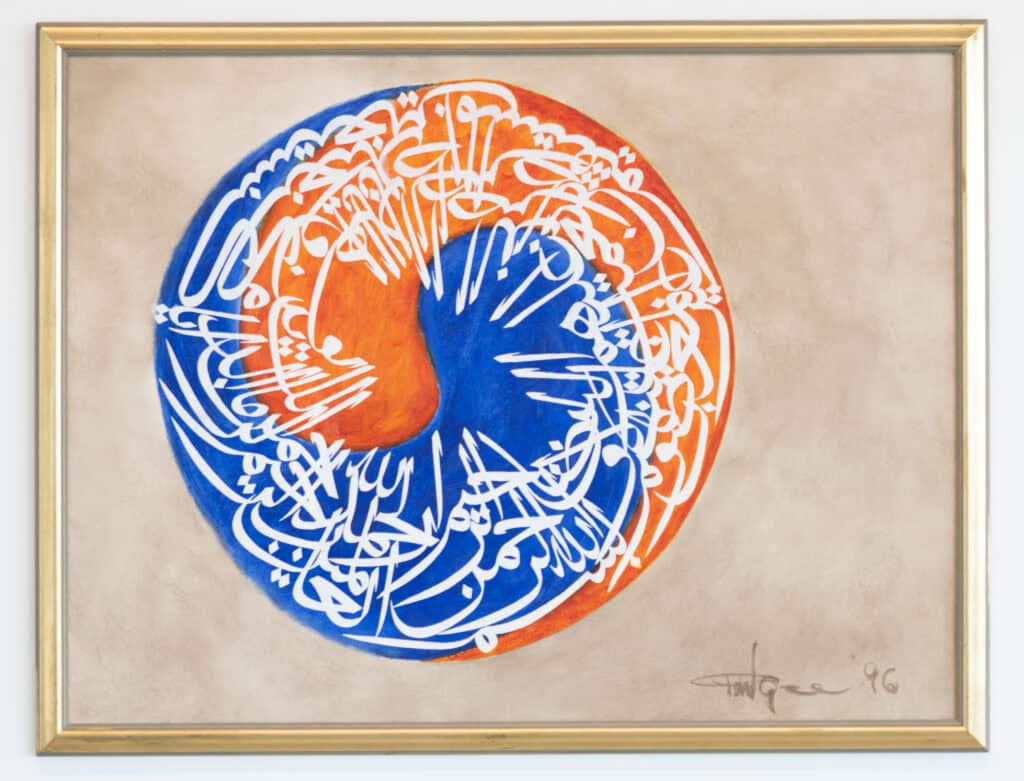
Due to its immense importance and centrality in the Quran and in Islamic faith, the artist has sketched the chapter in the shape of a sun or circle.
Surah Al-Fatiha chapter consists of seven verses, and each verse is marked by a circular pattern. In this art piece, the artist has used a stamp to conclude each verse. This stamp contains the testimony of faith of every Muslim, La Ilaha Il-Lah, Mohammad-ar Rasulilah. This testimony of faith is repeated four times in each stamp and one mirrors the other, which totals 28 times.
Ismail Gulgee (Abdul Mohammad Ismaili)
b. 1926
Surah-al-Fatiha
1996
Oil on canvas
46 x 38 in (116.84 × 96.52 cm)
Ismail Gulgee (Abdul Mohammad Ismaili)
b. 1926
Ismail Gulgee was a civil engineer who became an artist by choice in the 1950s. Working for over four decades, and mainly self-taught, he produced pencil sketches, calligraphic works, oil paintings, hardstone mosaics in varied compositions, and work in metal. He was wel-known for his incisive portraits of world leaders and royal personages. For architectural settings, he produced elements such as the crescents that surmount the dome of the Faisal Mosque in Islamabad, as well as its extraordinary mihrab in the form of a Qur’an open to pages from Surat al-Rahman in inlaid letters in Gulgee’s inimitable style of calligraphy. He gathered materials and inspirations from East and West, and spoke to his friends of “art as a journey, a pilgrimage, in search of a ‘there’ that unbeknown to us is also ‘here’, the continuation of an inner life, often no more than its visible externalization.” His work in calligraphy and other media can be found in various institutional settings and private collections throughout the Ismaili Muslim community