
Enigmatic Talismans
Enigmatic Talismans is inspired from the symbols found in Ethiopian healing scrolls. Ethiopian healing scrolls drew from Muslim and Christian traditions of talismanic art, and were prevalent in the northern regions of Ethiopia in the 19th century. Part of the healing ritual, the scrolls contained words and imagery that were used to alleviate spiritual symptoms of illness. The effectiveness of the talisman depended on the power of the gaze, where the eyes were the conduit for healing through a reciprocal gaze held between the person who was ill and the figurative imagery on the scroll. Islam Aly’s Enigmatic Talismans highlights the interplay between tradition and abstraction, drawing visual references from the imagery found in Ethiopian scrolls. The book blurs the boundaries between function and abstraction as the perforated, overlapping symbols evoke new interpretations.
Sacred Meanings
Sacred Meanings is based on the hexagon, one of the main shapes in creating grids and patterns in Islamic art. The form of the book, its words, and progression reveals the fading and development of a pattern. The book invites the viewer to consider his experiences with the transcendent and indivisible. Sacred Meanings presents an encounter that deals with the dichotomies of life, fall and rise, suspicion and faith, disorientation and orientation, chaos and order.
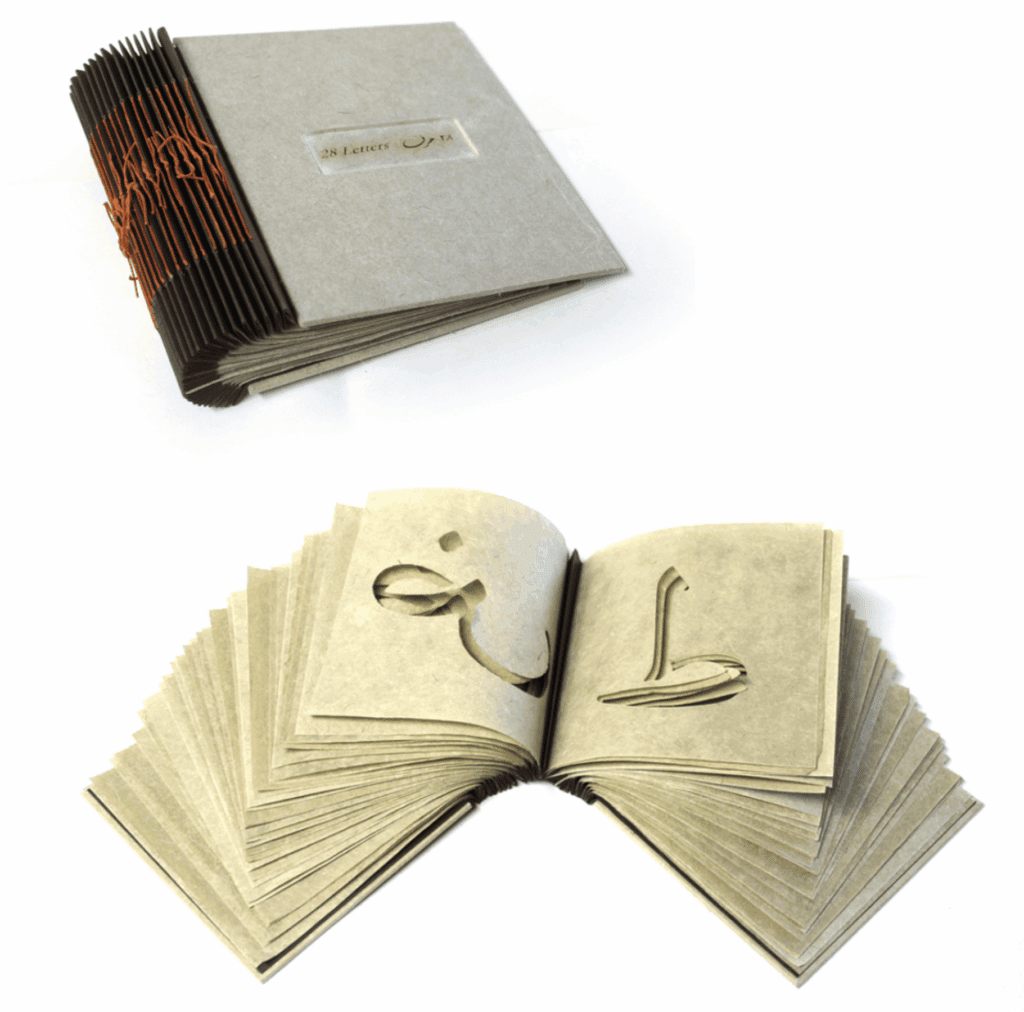
28 Letters
Islam Aly presents the 28 letters of the Arabic alphabet cut into an individual folio, transforming each page into a tactile surface that emphasizes the beauty of the Arabic script as both language and form. Bound in an accordion structure, the book invites the viewer to unfold, expand, and compress the work. Observing each letter on its own or overlapping with other letters, the work allows for a multitude of experiences. Light and shadow filter through the cutouts, creating a dialogue between presence and absence, legibility and abstraction.
Crucial Perimeter-1
Crucial Perimeter-1 explores the dichotomy between what’s inside a book and what’s outside. The book has no text or images on its folios. When the book is closed, the viewer can see the content on three edges of the book, but depending on how the book is opened, some of the content on the edges diffuses and becomes illegible, converting into traces of texture.
Crucial Perimeter-2
Islam Aly’s Crucial Perimeter-2 further challenges traditional expectations of where meaning resides by exploring the relationship between the interior and exterior of the book with the reader. This piece is bound with wooden covers that emphasize the physicality, weight, and connection to the natural world, and incorporates a modified Ethiopian and Coptic binding technique, referencing early bookbinding traditions. Like Crucial Perimeter-1, this book contains no text or images within its folios. Instead, meaning is displaced to the periphery, where the content appears on the outer edges of the book block, only visible when the book is closed. As the book opens and expands, the exterior pattern dissolves, examining the threshold of legibility.